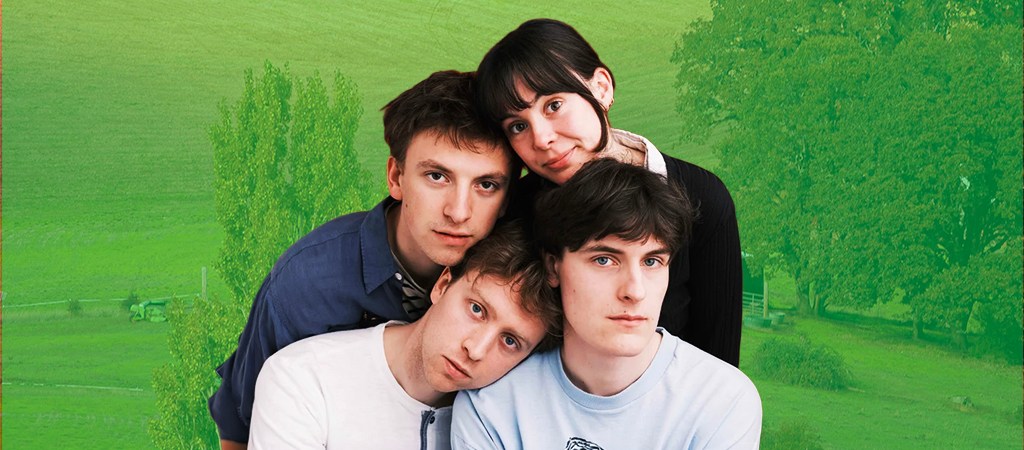

It Goes On, the scrappily invigorating full-length debut by the U.K. band Westside Cowboy, opens with one of the year’s most exciting rock songs. A rousing mess of relentlessly chugging guitars and shout-along vocals, “Kick Stones (The Boys)” has the spirited energy of a pub band that imagines it’s playing Wembley Stadium. As the song builds from jittery, tense strums and an insistent rhythmic pulse to a crescendo of noise and hoisted lager sprays, the idea that this band might actually play in a real stadium one day suddenly seems, shockingly, plausible.
According to singer/guitarist Jimmy Bradbury and drummer Paddy Murphy — who comprise half of this Manchester quartet that also has two well-regarded EPs to their credit — that “pub band imagines playing a stadium” vibe wasn’t far off from their artistic aims in the studio. As they explained during a recent transatlantic Zoom call, they wanted to make a simple — they both refer to it as “dumb” — and refreshingly straight-forward sound. A departure from standard-bearers of modern English indie like Black Midi and Black Country, New Road that have attracted a young, rabid following with much proggier and more theatrical forms of rock. Though for a while “Kick Stones” resembled “the wrong side of stadium rock,” Bradbury says.
“We knew we didn’t want it to sound like Only By the Night era Kings of Leon or Foo Fighters,” Murphy adds. “We knew the song wasn’t that, and we were scared that if we weren’t careful, it could fall.”
Instead, they modeled the song after “What Goes On” by the Velvet Underground — specifically a raucous live version recorded in the late sixties at a club in San Francisco. (Lou Reed acolytes will recognize the clanging rhythm guitar part nicked for “Kick Stones.”)
“That’s what rock and roll feels like to us,” Murphy says. “It’s about having these raggedy things pushed as far as they can go and feeling like the light fixtures in the windows are rattling because of it. We just wanted to go in that direction. I’m not saying that we really got there, but it became a new place to shoot for.”
Bradbury and Murphy’s love for American indie rock and folk music dovetails with a parallel fascination with the musical history of their own country, going back to seemingly arcane heroes of yesteryear like fifties skiffle hero Lonnie Donegan. They call this intersection of American and British roots music “Britainicana,” a jokey genre tag that’s actually evocative of the band’s musical M.O. Though for now, they have far more firsthand experience with the British side of the equation. While they’ve played overseas with Geese, which has helped to bolster their reputation at home to “indie phenom status,” they’ve only spent a handful of days in New York City and Los Angeles. Though they seem keen to see more.
“We’re hardly the first English band to be influenced by American shit,” Murphy says. “We love and sort of feel indoctrinated to a lot of the media that has come out of the place, but I think it’s harder these days to separate it from its politics, like with a lot of the world. Having said that, everywhere you go —this sounds maybe a little smushy — but there are beautiful people everywhere, and beautiful communities everywhere of people who are empathetic and really care about the things they care about.”
It’s interesting thinking about the back and forth of American and English rock bands. Speaking as an American, I’ve always thought of English musicians having a certain glamour or swagger that Americans don’t necessarily have.
JB: I think as English people, we don’t think we’re very cool. But we definitely see some bands, especially from New York and Chicago, like Horsegirl and Geese, where we’re like, “You guys look like the coolest people in the world.
PM: The grass is always greener. You guys had the Velvet Underground, so I feel like the conversation ends there of who had the cooler band.
JB: It kind of trumps a lot of what we’ve had.
PM: It feels like there’s a little more of a self-assuredness in American music. We love a lot of the folk music that’s come out of America. You’ve got some amazing storytellers — we’ve been fed Bob Dylan and Townes Van Zandt and the Velvet Underground and Talking Heads and The Ramones, and it goes on and on and on. Why wouldn’t we as impressionable teenagers not want to buy into that?
It’s been a weird thing in more recent times, because I think when you grow up, you grow up wanting to be something that you’re not, or going after something that you think is cooler, because, “Oh, my hometown’s so boring. I wish I was in New York in ’76 or something.”
JB: “Look what’s going on over there. They’ve got it good, haven’t they?”
PM: Then when you become an adult, you hopefully realize what is great about where you’re from. With the Britainicana thing, when we came up with it, that’s slightly more what we were getting at, honestly. Though I think sometimes people hear it and maybe zero in on the Americana thing. But it’s weirdly an acceptance and a championing and a realization of how much we love about our own country and our culture. Musically, that is.
Britainicana is such a funny word, though in another sense it’s also this big idea.
JB: People are like, “Well, you’re a bit post-punk, but you’re a bit indie.” And we’re like, “We’re just Britainicana.” Then, weirdly, that doesn’t shut down the conversation. That opens up another conversation of, what the hell is Britainicana?
You’ve just written the lead paragraph of every interview you’re going to have from now on.
PM: It was just kind of a joke when we started the band. Like, “We’ve only got three songs, but we’ve got our own genre.” It’s so ridiculous.
I also think it’s interesting how you stand apart from a lot of what’s coming out of British indie in the past several years. It’s been a lot of proggy, art-music sort of stuff, like Black Midi and Black Country New Road. Your band in contrast is much simpler and more “rock.” Was that a deliberate reaction?
JB: I think so. When we were starting this band, at that time, especially in Manchester, there was a lot of post-punk bands coming out, a lot of shoegaze bands, and Black Midi and Black Country were high points in popularity amongst people in our age group. I suppose Westside Cowboy is in some ways very anti that. How can we have fun in a band in as concise a way as possible? Instead of having six people on stage, let’s try and just do it with the most stock rock thing we could do — two guitars, bass, and drums, and write a song with three chords.
PM: I remember hearing [Black Midi and Black Country New Road] as a 17-year-old, and my head genuinely feeling like exploding because I thought it was so exciting and new, and I’d never heard anything like it. It’s such an amazing feeling when you do feel addressed by music like that as a kid, and we love both those bands. But they did it. What would we ever bring to that conversation that would be worthwhile that they haven’t done? It just happened at the time that we were becoming far more interested in what Jimmy was saying, “How dumb can we make music?” Because whilst all those bands are great and good people, you’ll go down to your local club or whatever and watch a load of terrible rip-off versions of these bands who are so pretentious, and don’t realize how pompous it all is and how elitist it all is.
JB: Whereas the originators of this are not that at all.
PM: Amazingly gifted, nice people, but some wanker 19-year-old playing in 7/4 on a weird tune would beg to differ. But all these things go in cycles, don’t they? I think we definitely saw a real joy and freedom in trying to dumb everything back down again. We didn’t think anything of it beyond that point. We didn’t think, “This is what needs to happen in music right now. We’ve got to take it back to the roots.”
“We’re going to start a revolution.”
PM: Yeah. “We’re going to change the course of rock history.” We just wanted to have fun with our fans.
You have mentioned Lonnie Donegan in previous interviews. Which is wild for a young band to reference in 2026. Is it true that you dabbled in skiffle at one point?
JB: Sort of, for about a week. And then when we did our first gig. We still told people we were a skiffle band, but an electric skiffle band. It’s a weird story. Around the time of starting this band, I got really into this book of the history of skiffle.
PM: The Billy Bragg one, yeah.
JB: What I got from it was that skiffle was one of the very first DIY youth music scenes in England in the mid ’50s. We didn’t really have Elvis until 1956, by the sounds of it, and he’d already been going a couple of years at that point. In England, it was really hard to get electric guitars or many musical instruments from America, and certain records you couldn’t get. England was kind of drip-fed Little Richard songs, and Carl Perkins and stuff like that, from sailors and soldiers that would bring them from America. And they end up in Liverpool, and then you end up with four guys from Liverpool starting a band, and that goes into another direction. But I just really liked the idea that kids would hear someone like Lonnie Donegan on the radio, and he’d try and play a folk song as fast as possible, smacking the shit out of an acoustic guitar, and it made all these kids want to go out and learn guitar.
Some kids couldn’t find guitars or instruments, so they made their own. Have you heard of a tea chest bass? It’s a wooden box, like a tea chest, with a broom handle, and you tie a piece of string to either end, and you pull back the broom handle to create tension, and you’ve got an upright bass. All these kids would go play in coffee bars. I think that was so cool.
For your band this seems like a means to an end. You were never going to be the Mumford & Sons of skiffle.
JB: No, no. I think it was very much an instigator of, “Let’s do something simple, that sounds fun,” kind of thing.