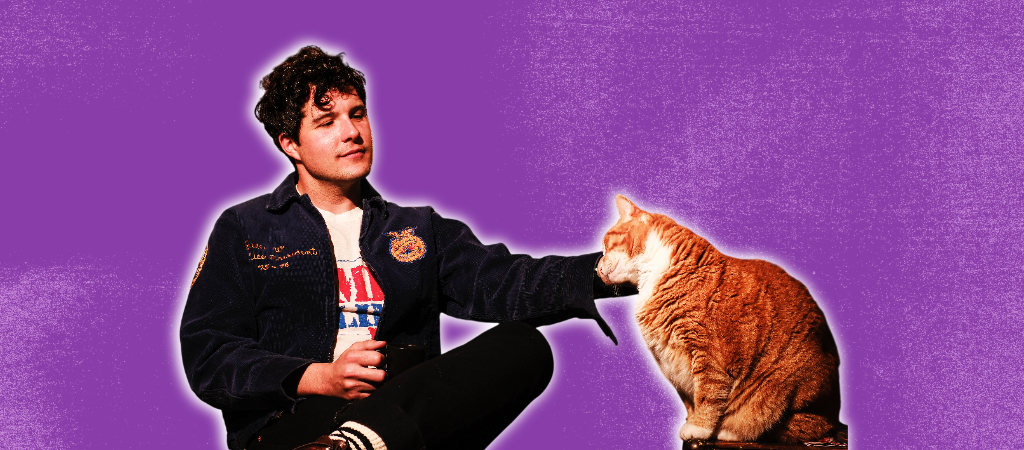

Growing up in the aughts, Brian Dunne was a kid out of time. The second child from his father’s second marriage, he was raised by a Vietnam veteran who played Vietnam era rock (CCR, The Animals, etc.) around the house. The milieu of his hometown — 90 minutes north of New York City, “a real ‘cops and firefighters’ town,” he says — was working class, but most kids his age were still listening to The Strokes and The White Stripes. Dunne, meanwhile, was sneaking off to the local video store to rent Bruce Springsteen’s Video Anthology/1978-88. He was specifically clued into the video’s first clip, the one of the Boss playing “Rosalita” at the Pheonix Memorial Coliseum in 1978, which famously ends with Bruce being mobbed on stage by several women.
“I just was like, ‘My God, that’s it for me, man,'” Dunne, 36, recalled. “That was the genesis point of getting into music, and then I never looked back.”
It hasn’t exactly been an easy road — “thunder” or otherwise — for the singer-songwriter since then. He’s been making music for more than a decade, mostly in obscurity, including a stint on the stalwart indie label Kill Rock Stars, an odd fit given the solidly pro-“classic rock” bent of his music. A student of old-school heartland rock — Tom Petty, Billy Joel and John Mellencamp, along with Springsteen, are obvious influences — Dunne makes the kind of music destined to dominate FM radio… if it were still 1989. Unlike most of his peers similarly invested in denim-clad guitar jams, he makes no attempt to distance himself from his antecedents, either sonically (his music is unabashedly shiny and accessible) or lyrically (he embraces earnestness and eschews cynicism). If there’s such a thing as being stubbornly, even subversively, committed to “normal” sounding pop rock, Dunne is it.
In 2021, his career got a surprising boost when he formed the band Fantastic Cat with three other similarly crafty journeymen singer-songwriters — Anthony D’Amato, Don DiLego, and Mike Montali — determined to cut loose from the cookie-cutter self-seriousness that plagues the “crafty journeyman singer-songwriter” genre. As Dunne himself puts it, “We’re all singer-songwriters, and we’d all taken those press photos where you’re just looking super serious. And we were just like, ‘I can’t think of something I would want to do less than another project that’s just self-serious. And the bio is like, it’s their most personal work yet.’ I just am personally so sick of that myself. We were like, ‘We have to have more fun.'”
Prone to trading instruments between songs while leaning into a loose, party-friendly vibe, Fantastic Cat’s live shows have garnered them a cult following on the road, evoking the blue-collar good-time pub-rock of Rockpile along with the rootsy 2010s-era folk-rock collective Middle Brother. (Of course, I’m required to also describe them as “a much humbler version of the Traveling Wilburys.”)
And now Dunne is prepared to give the band a lift of his own. Their winning third album Cat Out Of Hell (due April 10) comes on the heels of Dunne’s 2025 record <em>Clams Casino, a critical hit that landed at No. 4 on my personal year-end list. If the jokey Meat Loaf reference didn’t tip you, part of Dunne’s appeal is his self-deprecating manner and casually expert knowledge of rock history. For instance, our interview was sidetracked by an extended tangent rating the deep cuts from Springsteen’s mostly forgotten early ’90s album Human Touch. (Yes to “Gloria’s Eyes,” no to “Real Man,” maybe to “Soul Driver.”)
I relate to your story about connecting with Springsteen at an early age. What was it about that music — or Springsteen as an archetype — that connected with you?
I think, early on, I recognized the world that he was singing about. Because I couldn’t have possibly understood the emotional nuance of The River. How could you have had the tools to understand that? But my dad fought in Vietnam and he worked in a factory, and my mom’s a legal secretary and still is, and I knew where the auto plant in Mahwah was.
You’ve described Clams Casino as a record where you were trying to sound like the New Jersey Transit. By the way, I did not know that Clams Casino referenced a regional dish. I thought it was a nod to the indie producer. I wonder how many people checked out your album because they thought it was funny that a singer-songwriter dude was referencing Clams Casino. I don’t think I’m alone.
I’ll take the accidental association. I don’t think myself and the producer Clams Casino have much in common musically, but on some level, I was trying to sit at the same lunch table and it might’ve been subconscious. But no, I was most likely thinking about Billy Joel and how to use food as an example of classicism.
The album title denotes a certain place, obviously, but it also conveys a certain style or status. What’s interesting about you, in my view, is how you take these classic-rock influences and don’t apply any of the distancing devices that are typical in the indie rock world. You aren’t coming up at it from an ironic perspective, or from a “lo-fi basement” aesthetic. You’re making records that, sonically, could have come out during the “heartland rock” era.
Yeah, a thousand percent. You’re right on the nose. There’s a couple things at play there. The first is, I believe in New York City, I talk about it ad nauseum, but a lot of the music that comes out in New York are people posturing as New York bands. There’s a lot of turning your collar up on Bowery. Don’t get me wrong, it’s not like I don’t understand why a group of young kids would move here and want to sound like Marquee Moon and not Storm Front. But after being here for 15 years, it started to read to me as bourgeois. Why don’t people sing about regional New York? People sing about the regional South. People in the South are not afraid to sing about their roots. But for some reason, New York bands always feel like they’re supposed to have just fallen out of the back of a car on Bowery at age 22. I just had this moment where I was like, “These are just simply the songs I want to hear. So, if nobody else is going to write them, then I will.”
Other artists in the indie world are doing that. But it usually comes out sounding like The War On Drugs.
I think a lot about a band like The War On Drugs, because they’re also a huge jump-off point for me. That was the first time I realized that a lot of the indie rock I love is kicking the tires on what can be used. The first time I heard A Deeper Understanding, I thought, “Oh, so we can do Bruce Hornsby? We can do Tunnel Of Love?” Those were non-starters just a few years before.
And I think a lot about Father Of The Bride, the Vampire Weekend record. I remember listening to the first single that came out, like “Harmony Hall” and “This Life.” And I remember thinking, “Is it just me or does this sound a little bit like Billy Joel? Are we allowed to do that? Are we allowed in indie rock to do that?” That’s kind of exciting for me, and I just want to keep continuing on to see what we can get away with. And I’ll probably take it too far at one point and everybody will hate that record.
So far, so good.
In the moment when I was making the Clams Casino record, I was thinking about John Mellencamp. I understand why indie rock bands do not reference John Mellencamp. You can reference Bruce Springsteen, but you can’t really reference John Mellencamp. But I was just trying to wade into those waters to see if maybe you could, if you’re very discerning.
I think Mellencamp is “acceptable,” just not in indie rock. But in whatever the “Americana” genre is, he seems like a relevant influence. I’ve seen you also get classified as “Americana,” which supports my belief that music that once was called “heartland rock” — or just “rock” in the mainstream — now just gets lumped under the Americana banner.
I understand why an Americana outlet would view me through that lens. And I frankly have spent enough time toiling around in total obscurity that I’ll do whatever. [Laughs.]
But circling back to what I was saying earlier: I think your music would have just been considered mainstream rock 30 or 40 years ago, and your songs would have been on the radio. It’s funny to me that music so approachable and likeable is now a niche form of guitar music.
In some ways, that’s more exciting to me. I don’t think I personally would want to be in the mainstream. I don’t live a mainstream life, but I cannot deny that the beating pulse of my creative heart are those things. And I like the idea that that can be rarefied air. I certainly tried at times where I wasn’t so confident in who I was and felt like I had to flip the script a little bit. I was signed to Kill Rock Stars, that was the first label that signed me. So, I definitely felt a little bit of pressure to make a slightly more esoteric record. But ultimately, you excrete what you ingest.
Let’s talk about Fantastic Cat. A lot of “supergroup” ensembles get compared to the Traveling Wilburys, but in your press materials, you reference Rockpile, the band that Nick Lowe and Nick Edmunds fronted in the late ’70s and early ’80s. And I think that suits the mix of looseness and craftsmanship that imbues the project.
It sounds obvious, but how much of a revelation it is that people want to come see people that are genuinely just having a good time? It should have been so obvious to me for so many years, but I probably was walking on stage throughout my 20s with so much emotional baggage that it probably was stressful for the audience. The band is still at its very early stages and still trying to break through to the general population, but there’s a groundswell we’ve seen at our shows where it sells way more tickets than frankly it should in terms of its internet footprint. And I think it’s just because it’s a guaranteed blast. We are always having a great time and the songs are really good. And you’re also watching somebody on stage be genuinely challenged. Every time I sit behind the drum kit, I’m like, “Okay, we’ll see what’s going to happen here.”
A striking thing about Fantastic Cat is how it seems like a “real” band in a way collectives like this rarely do. I often can’t tell who is singing what song, just because your varying styles really mesh together seamlessly. How do you maintain that spirit without egos getting in the way?
It’s an interesting question. I mean, we get along really good because we’re all pretty good friends. And I think that the real avoidance is that we are older. I am the baby of the band and I’m going to be 37 in May. I also know what awaits me. When you’re 22 and you’re writing songs with other people and you’ve not yet stepped out on your own, the prospect of that is always on the table. The “I’ve got my own album to do” of it all. But none of us has to threaten to go solo. We already are solo. If ever there is anything I am frustrated about, I just put it on my next record.
Cat Out Of Hell is out 4/10 via Missing Piece Records. Find more information here.