
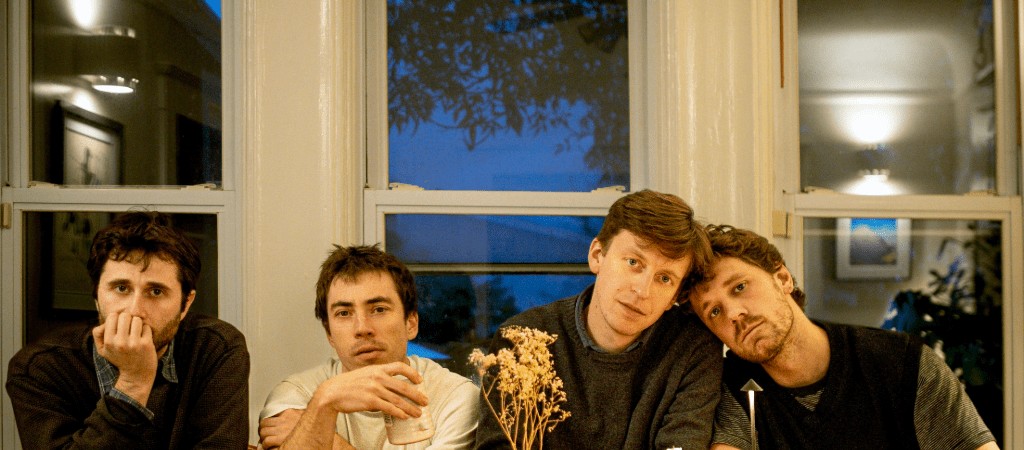

To hear the guys in Mildred tell it, their band didn’t form so much as fall in together. Back around 2022, three of the four members — singer-guitarist Henry Easton Koehler and Jack Schrott, and singer-bassist Matt Palmquist — were living together in a house in Berkeley and bonding over beers and Silver Jews songs. They were all around 30 years old, give or take a few years, and working day jobs or pursuing academic degrees. Though like the rest of the world they had just been temporarily grounded by the pandemic.
During that time, whenever drummer Will Fortna dropped in while visiting from out of town, their hangs sometimes took place with instruments in hand. Over time, songs started coming out of those impromptu jams. Even more gradually, those tunes were finetuned into something good, and then something, well, pretty great, actually.
You can hear the result of those cozy, meandering bull sessions on Mildred’s full-length debut, Fenceline, one of 2026’s most endearing sleepers. Like a David Berman record if the late, great singer-songwriter had relocated to northern California and started emulating The Band and CSNY, Fenceline is composed of low-key, highly observational character studies set to quietly invigorating folk-rock. It all sounds like it was played live in a room. All the better to capture the natural-as-breathing chemistry between the four principals, whose instrumental parts feel organically rendered while locking into one another like complex embroidery.
I’ve been listening to it constantly since it showed up in my inbox ahead of its late April release. A record of simple and unassuming pleasures, Fenceline is loaded with small moments that land big the more you spend time with it, like the guitar solo that suddenly cuts off at the end of “Fish Sticks” or the backing vocals echoing like a campfire sing-along in “Charlie” or the way the repeated refrain of “Aquinas” (“I was thinkin’ about dyin’”) lingers in the mind long after the record ends.
It feels delicate and tough at the same time, created by a true band whose members appear to be genuinely ego-less. For Fenceline, all four guys pitched in on the songs — one might bring in the germ of an idea, while the others pitched in lyrics or arrangement ideas. When I spoke with Koehler and Fortna last week over Zoom, they were adamant about the band having no leader or hierarchy. When I mentioned that most bands need some kind of “boss” to function, they were politely insistent about Mildred existing as an “organic” — a word they used seven times in a half-hour interview — co-op of sorts.
“Just four mellow dudes hanging out, drinking beer and playing music?” I asked.
“Pretty much,” Fortna replied, laughing.
“You got us,” Koehler added.
You all started this band relatively late in life. What brought you to this point?
Henry: Jack and I grew up together in Portland, and we grew up playing music together. Will and I are actually cousins, but I didn’t really know he existed. But we met through a mutual cousin who introduced us and quickly bonded over music and started playing music together. And then Matt and Jack and I were housemates.
Will: I played in a bunch of bands in London, and in the first half of my 20s very much my life was just music and trying to be able to live as a musician. And then I thought I gave that up for good, moving to America to go to law school in the second half of my 20s. But then I connected with these guys. We just started playing music in the house they were living in, before dinner and after dinner in the living room. We didn’t have any real designs to start making a band band or playing shows. This all happened very organically.
Henry: It was mostly just like, Let’s put this thing together and maybe try to get some gigs around town. But I think we quickly started enjoying it more and more. And then we went on a tour a couple years ago, our first time playing outside of the Bay Area, with our friend Naima Bock. And that was, at least for me, the moment of This is something that is super meaningful and we want to do and take a lot more seriously.
I hear from musicians all the time that the lockdown era was a time when a lot of projects got started. It sounds like that was also true for Mildred?
Henry: We definitely had songs laying around that were written in that pandemic era. Once things started opening up a little more, we just had some material laying around and then Will was suddenly living in the same area. So, it made it easy to be like, We can just play these songs and then maybe we can record these songs and then tour these songs a little bit. But through the pandemic, there was a lot of just sitting around and talking about music and listening to music. Music was a big part of our lives in that house.
What music were you bonding over?
Henry: I was pretty manically into the Silver Jews. Will had just introduced me to David Berman, not long after Purple Mountains came out. I remember we were driving over the Golden Gate Bridge and Will was like, “This is one of my favorite bands. They’re called Silver Jews.” And I was like, “What is this drab indie music? This is not resonating with me at all.” This was not long after we had met. And then I kept hearing about them, and pretty soon got hooked.
The biggest musical memory I have of the pandemic is just restlessly ambling about our house with David Berman couplets in my head and just singing them in a somewhat crazed way. There was a lot of sitting around and drinking beers. And we had a drum kit in the living room and guitars laying around. People would just cycle in and out of the living room and play music, covers, originals, little ditties that they were working on. And every once in a while, the three of us would end up playing together.
Your record reminds me of Silver Jews if David Berman lived in northern California and was also influenced by CSNY.
Will: I love that description.
Henry: I would say none of us are big CSNY heads, but we’ve gotten that comparison a little bit over the years and I take it as a compliment. And I think we all love singing together and harmonizing.
Your band is unique in that you don’t have just one or two primary songwriters. How exactly does your collaboration work?
Henry: The process really revolved around us playing together every week. Band members would bring pretty raw, unfinished snippets of songs and we would just flesh them out together and encourage each other to finish said songs. Sometimes Will or Jack or Matt would be like, “I really like that line. You should keep it.” Or suggest new lines. So, even though each of us wrote individual songs, that sort of authorship was, I think, porous.
Even if there’s not a “leader,” per se, do you guys fall into different roles?
Henry: At least for this album, Jack and I were a little more song-focused and Matt and Will were a little more bringing the “arrangement and producer” brain. But those roles definitely aren’t fixed. We’re working on our next batch of songs right now and Will’s writing a lot of songs, too. So, I think everyone does a little bit of everything, which makes it really fun, at least for me, because you get to be in a position of like, “Hey, how do I service this song as a guitar player?” But then you also get to be a lead singer. It keeps things really fun and exciting.
There’s a reason why most bands have some sort of hierarchy — it can be hard to function without a “chain of command,” so to speak. Just from an interpersonal perspective, how do you make this democracy work?
Will: I feel like the biggest disagreements we have are less on music and more on some bullshit social media posts. The phrasing on an Instagram post or something. But the important stuff, the music, we’re very receptive to each other’s ideas and it just feels very natural.
Henry: I also think we’re all pretty self-aware and self-deprecating. We also use a lot of humor to get through those things when they come up.
I’ve been meaning to ask: How did you land on Mildred as a band name?
Henry: Before we really had any idea of being a band, we had a lot of joke band names. And Mildred was a part of another jokey band name. And then when we were thinking about more serious band names, I think it just felt good to us. We all maybe project different things onto the name about what it means for us.
What does it mean to you?
Henry: For me, I’ve always just liked old guttural names.
It’s not guttural though. It makes me think of an elegant woman from the 1920s or something.
Will: Totally. That’s what I picture. I like that it’s not cool or edgy or flashy because I feel like we’re none of those things.