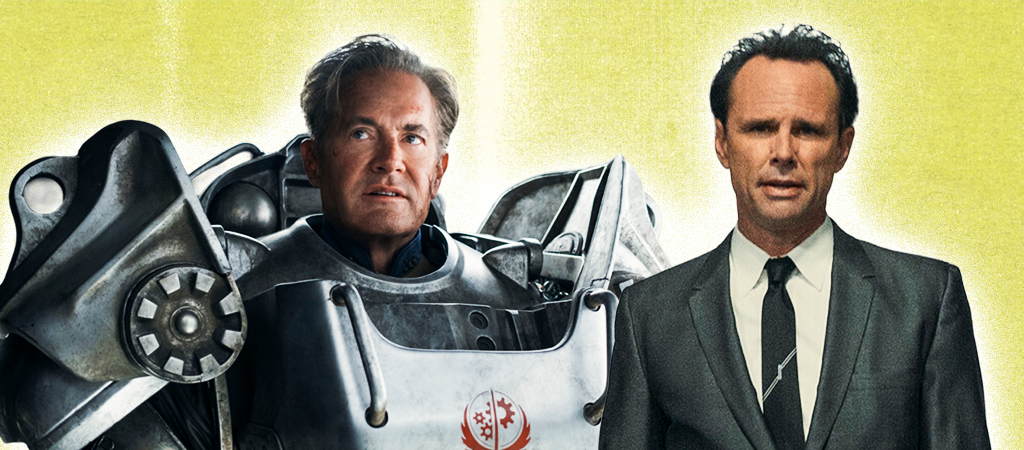

The first season of Prime Video’s Fallout gleefully detonated our expectations of what an open-world video game adaptation could be. Set centuries after nuclear annihilation, the show dropped viewers into a garish, atompunk wasteland where retro-futurist Americana rubbed up against desert-dusted violence, warped humor, and deeply human stakes. Produced by Westworld’s Lisa Joy and Jonathan Nolan, the show overflowed with unhinged characters – sheltered do-gooders, undead ghouls, power armor outfitted opportunists – and even more bizarre worlds – vaults, wastelands, and techno-religious cults, just to name a few. The result? A post-apocalypse that was weird, funny, brutal, and, crucially, unburdened by the genre’s usual self-seriousness.
It should come as welcome news then, that Fallout’s buzzed-about second season doubles down on all of the deranged, deliciously strange choices made in its first outing, oozing some well-earned confidence as it swings bolder and bigger. Star Kyle MacLachlan thinks so too. “Season two is even better because we’re leaning in more,” he tells UPROXX while teasing his character, Hank MacLean’s, heel turn. “We’re more comfortable, I think, with the characters and what we’re doing. The scope of it is opened up even more. You really get a sense of the size and the scale of these worlds, and it’s pretty exciting.”
MacLachlan’s no stranger to what makes for good TV, but even he was surprised by his character’s personality pivot in the season one finale. As MacLean, the actor spent most of his screen-time playing a doting, vault-dwelling dad taken hostage by a group of raiders with ulterior motives. It was his kidnapping that sent Ella Purnell’s Lucy, the show’s de-facto heroine, topside for the first time, emerging from the underground bunker she called home to trek across the California desert in search of her father and answers surrounding his questionable past. By the end of season one, Lucy (and the audience) learned the damning truth: Hank MacLean was simply another Vault-Tec fanatic, fully drunk on the Kool-Aid of a perfectly-controlled world, who was willing to commit genocidal atrocities to see his company’s vision come to life.
In season two, Hank drops the nice guy act completely, though he’s still torn between fealty to his human popsicle overlords and his daughter. “He still maintains such a strong love for his daughter, and yet at the same time, he has this allegiance, of course, to what he’s supposed to do. He is a man who does not shirk that responsibility,” MacLachlan says. “So the exciting thing for me was being able to stretch the distance between those, to play back and forth inside that.”
Diving into the twisted psyche of his character wasn’t an acting privilege reserved solely for MacLachlan though. Every cast member was pushed to their limits in some form this time around. For Walton Goggins, who raced from Thailand to the Mojave desert, swapping his White Lotus digs for a literal camper van, season two demanded he fully inhabit two very different men: the gun-slinging, shit-talking mutant known as The Ghoul, and Cooper Howard, the pre-war Hollywood cowboy who spent the last half of season one reckoning with the reveal that his own wife was planning a nuclear strike in the name of capitalism.
“In season one, you get to spend some time with Cooper. You understand who he is, you get to see the world as it was through his experience before the bombs dropped,” Goggins says. “But it was really more about The Ghoul, wasn’t it? And his journey through the wasteland. This season is no different. The Ghoul is on a journey, and most people won’t see where it’s going, but it’s Cooper Howard that I just didn’t guess.”
“I’m excited for people to see who he is and how it is a reflection of what’s going on in the world today. For me, Cooper Howard’s journey was about a person who didn’t understand what he didn’t know, and he’s seeing the world change in real time, starting with what happened at the end of season one, learning his wife is a principal architect of the ending of the world. How do you really process that?”
While The Ghoul and Lucy continue their buddy comedy road movie schtick as they slaughter their way to New Vegas in the show’s present day, in the past, Cooper is really going through it. “He is way out on a limb. He’s very, very, very vulnerable,” Goggins says. “Where it winds up for him and what it reveals about this world was surprising, even to me.”
Nuclear warfare, familial betrayal, zombified Elvis impersonators, and bloodthirsty bros who most definitely think about the Roman Empire more than once a day – it all fills this new world Fallout is building in season two, and it can be a lot to process. That’s especially true when you’re weighted down by prosthetics and expectations. But Goggins had a unique way to unwind during filming. He embraced that van life.
“I got this van during COVID,” Goggins says of his 22-foot Mercedes Sprinter he named Vacilando. “It was always a dream of mine to have the freedom to go anywhere that I wanted to go and stay for as long as I wanted to with my son and really kind of get out into nature.” Now, it’s something he can deploy on set, allowing him a chance to immerse more with Fallout‘s unique setting.
“We were filming out in the desert, close to the Nevada border, and instead of staying in a hotel and all of these locations where we filmed, I just drove my van there,” he continues. “Everybody else would go home for the night and they would have just me and a security guard watching over the rest of the equipment. And I would just make myself food and listen to music and camp out in the wasteland. The desert is some of my favorite topography in the world, and it was getting the opportunity to live in these places in a way that I had never lived in, while staying on set. I got up at four in the morning, would have my coffee, watch the stars, see the sun rise, and then it took me four steps to get to the makeup trailer.”
Goggins has a way of making the end of the world sound kinda beautiful.
Season two of Prime Video’s Fallout is streaming now.