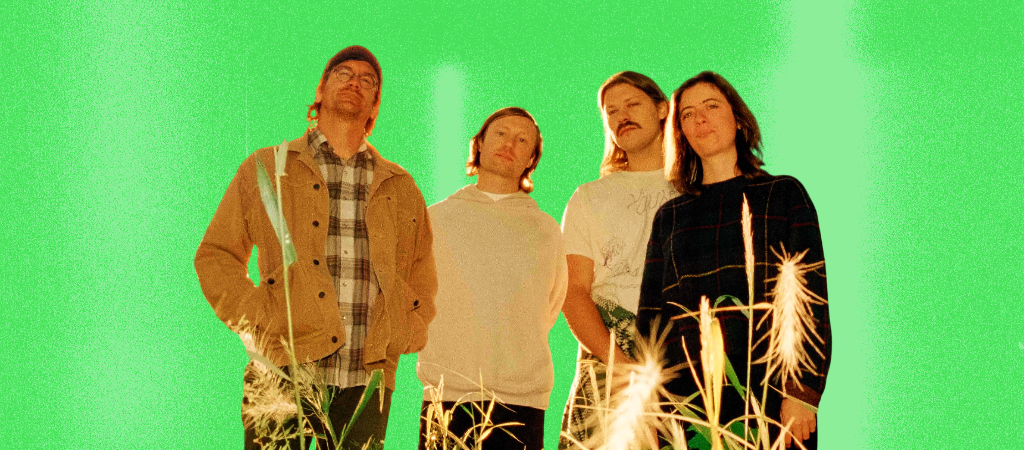

If you know anything about the Chicago indie-rock band Ratboys, it probably concerns their likeability. Ratboys are a likeable band. They are likeable because they make really good music, and they are likeable because they have made really good music consistently over the course of 11 years and six albums. (Their latest, Singin’ To An Empty Chair, arrives February 6.) But they are also likeable because they work hard, they travel pretty much anywhere and everywhere, and they do their jobs with kindness and professionalism. They are likeable the way your mailman is likeable.
The “Ratboys are likeable” narrative is the bedrock of Ratboys’ media coverage. And that is all well and good. But let’s be frank: This is boring. And I’m convinced it doesn’t tell the whole story. What, for instance, is unlikeable about this band? Why doesn’t anyone ever ask about that? What are these people hiding?
“Oh, that’s such a good question,” Ratboys singer-songwriter Julia Steiner replied when I brought this up during a recent phone conversation. Her voice was bright, sunny, and warm. I could use another word to describe her tone, an adjective that starts with “L.” But I won’t.
“Holy crap,” she continued. “I wish the guys were on the call because nothing’s coming to mind.”
So, you’re saying the guys are the unlikeable ones in the band?
“They’re probably pretty unlikable,” Steiner said. She was joking. It was quite charming. And also really lik- ah, Jesus Christ.
“No, God, I’m trying to think. I mean, I definitely have fixations on art that most people wouldn’t tolerate. In the van, I sometimes force the guys to listen to… well, actually I don’t force them. I’ve learned my lesson about that. I love listening to show tunes and I’m pretty obsessed to maybe an unhealthy degree with the 2019 film Cats. I love terrifying uncanny valley art, but that’s not unlikable.”
No, Julia, it’s not. A fixation on a campy cinematic disaster, again, is quite charming! It’s like in a job interview when you ask someone, “What is your worst trait?” And the person says, “I work too hard.”
“Yeah, that’s kind of a cop-out answer,” Steiner admitted. “I mean, this is something that I talk about with my sister. I brought it up with her yesterday, I’m like, ‘Man, I’m the least mysterious person on the planet, so it’s hard for me to kind of build that up. I wouldn’t even really want to try artificially.'”
This was going nowhere fast. I hadn’t yet gotten around to Singin’ To An Empty Chair, a hyper-catchy pop-rock record with some seriously dark overtones. Darker, in fact, than any Ratboys album yet. It was recorded at a cabin in the “driftless area” of southwestern Wisconsin, a region that sounds foreboding on paper but in reality is a scenic landscape composed of green rolling hills, lakes loaded with pontoon boats, and small towns outfitted with bountiful go-kart tracks and drive-in burger places.
Which explains why Empty Chair (at least musically) is hardly a Bon Iver-esque isolationist downer, but rather a sonic expansion of Ratboys’ usual mix of crunchy emo-pop and punky alt-country. The music contrasts with Steiner’s introspective lyrics, which dwell on the challenges of interpersonal communication while veering into therapy-speak. (The title alludes to a psychiatric exercise in which a patient speaks to an imagined person.) Steiner had an unnamed estranged loved one in mind when she was writing songs like the album’s eight-minute centerpiece “Just Want You To Know The Truth,” where she seems to address a family member: “Once you left home / we cleaned out the house / came upon some skeleton / that none of us knew shit about / if I told you I was okay / well that would have been a lie / so, I blocked your telephone / without sayin’ goodbye.”
This is heavy subject matter, and I’m not surprised when Steiner says that she’s more open in the song than she’s been in real life. “I’m working my way toward being able to say these things without an open-E guitar and a big-ass band behind me,” she told me.
Are you trying to communicate with this person with this album?
Yeah. I mean, my plan has been to send it off, you know what I mean? Get a CD copy and put it in the mail. Not just by itself, that would probably be pretty psychotic, but with a short letter just bridging the gap and saying like, “A lot of these songs are about us, and I hope you like them and listen to them.”
It feels a little bit selfish to have this album as a communication tool for me, but life is short and I’m willing to try. I’m willing to go to great lengths to repair a broken relationship, so that’s where we’re at. I hope I don’t chicken out.
You mentioned going to therapy. How has that influenced you as an artist?
It’s just a level of structure and clarity that I really appreciate. The specific thing that I got out of this was this exercise that I tried, the Empty Chair Technique, and it really unlocked this song, “Just Want You To Know The Truth,” which is the emotional centerpiece of the album. It’s the main confrontation, if you will, or the firmest gesture of extending a hand.
I was really struggling in writing that song. I had that little hook, and I had this idea of sort of chronologically venturing through these different snapshots of my life and moving from the past to present and seeing how the scope of everything led us to where we are. But I was getting in my own way a lot, shooting down ideas before they even were fleshed out. My therapist suggested this Empty Chair Technique idea, and was she wasn’t pushy about it. She just proposed it and said, “Make of this what you will.” And I gave it a go and recorded myself and listened back. And that really did help me unlock the, God, story of my life, for lack of a better word.
Has that introspection caused you to look at older songs you’ve written and realize, “Oh, I was actually writing about this“?
I’m still trying to figure that out about a lot of stuff. I’ve had this impulse in the past as an English major to want to ask a writer about a specific line like, “What was your intention? What did you mean here?” And I’ve realized on the other side of it, writing creatively or poetically in any sense, that’s the worst question to ask a writer because they often are still not sure. So that is how I think of some of our older songs. I’m waiting for them to reveal themselves.
I was joking about this earlier, but does it ever get annoying to be talked about as this nice Midwestern rock band?
We had a bit of a moment, the four of us, I think, on the last record. I don’t remember which outlet it was, but someone called us “that charming little band” or something, and we were like, “What? That is such a backhanded compliment.” I would just encourage people to listen to the songs and there’s some heaviness and weight there and grit.
I was thinking of the trajectory of Ratboys, and it’s been this slow and steady climb, where every record seems to do a little better than the last, but it’s never a dramatic shift. It reminds me of R.E.M. in the 1980s or The National in the aughts.
Or Spoon.
Yes, exactly. Obviously, you have no control of that. But it does seem to suit the band’s personality.
Kind of, yeah. I mean, we’ve fully embraced the gradual growth approach. If we hadn’t, we would be truly driving ourselves insane at this point because when you want or expect some sort of immediate life-changing success and you don’t get it, what are you left with? Just total disappointment.
We come from a background of playing in basements for no one. Literally no one. Maybe this is the reason people keep saying we’re this charming little underground band or whatever, but we still have the mindset when people come to our shows and we don’t know them, it’s such a win. We love band practice and love playing these songs by ourselves, and so any audience that comes just to hear the music is a bonus. We’re going to have a great time no matter what and the fact that people come out to see us is all we could want.
Obviously, we would have loved to been able to start playing bigger rooms sooner. We’re not trying to stay small forever. And, honestly, none of us make a living from this band, so that’s our goal. In a perfect world, we would have more eyes on us and be able to keep playing, selling more tickets and selling more records and be able to sustain ourselves. Bu we would never expect that to happen, go viral, any of that bullshit. It’s just so out of our control.
Have you ever had a moment where you thought, “We’re about to blow up,” and it didn’t happen?
It kind of felt like on our third record, Printer’s Devil, that we were going to have this breakout moment. We really felt that that record was a huge level-up and something new, and we had a big tour booked and all that. And then everything just went away with COVID, which isn’t a story unique to us at all. You can’t control the timing and the way the world spins.
I’ve been thinking a lot lately about bands, and what it means to have a band identity. Obviously, bands have always existed. But in the mainstream, it seems like the pendulum has swung so far in favor of solo artists for a long time. And now I wonder if it’s swinging back a bit. Ratboys have been a band for more than a decade. But you could have just as easily billed yourselves as “Julia Steiner” and played with the same musicians. And maybe that would have even been better marketing in the 2010s and early 2020s. But you didn’t do that, which makes me think you also care about bands. Why is that?
I haven’t thought about this in a long time, but this brings back a memory when — a long, long time ago — Dave [Sagan, the guitarist] and I were in the position of needing to change our band name. At the very beginning we were just Ratboy, no “S,” and we got sent a threatening email from another Ratboy and we needed to figure out what to do. And we deliberated so much on different ideas. My dad at the time was like, “Why don’t you just go by your name?” And I was, for whatever reason, very resistant to that and we ended up just adding the S.
It’s funny to think back because we didn’t really have a band back then, it was just me and Dave. But from the very beginning, even before Marcus [Nuccio, the drummer] and Sean [Neumann, the bassist] came into the fold, I really saw the value in Dave’s contributions and wouldn’t want to shine the light on myself. It’s hard to explain, but Dave provides this really tangible but also subconscious structure for the songs. And he’s just as much a Ratboy as I am.
As a music fan, I’m so obsessive and nerdy about The Beatles and parsing a song out and thinking about what each person is doing at any given time. Same goes with Wilco, who are one of my favorite bands ever.
Wilco is a good example of what I’m talking about. The songs mean something different coming from a band than from “Jeff Tweedy,” even if that difference is somewhat subliminal.
I hope this Geese phenomenon — obviously Cameron Winter has a solo record and everything — but Geese is such a kick-ass band and the thing that happens when they all play in the room together is so special. We saw it at Pickathon last year. And hopefully kids realize that that’s the thing that is so transcendent here. Obviously, it’s what they bring uniquely, but also it’s the story of band in a room rocking your face off.
Singin’ To An Empty Chair is out 2/6 via New West Records. Find more information here.